
Anna PolaniTuning Fork of Silence
Tuning Fork of Silence
Digital sculpture and 3D animation
A joint project by Pravila Zhizni and the Sber Science Award
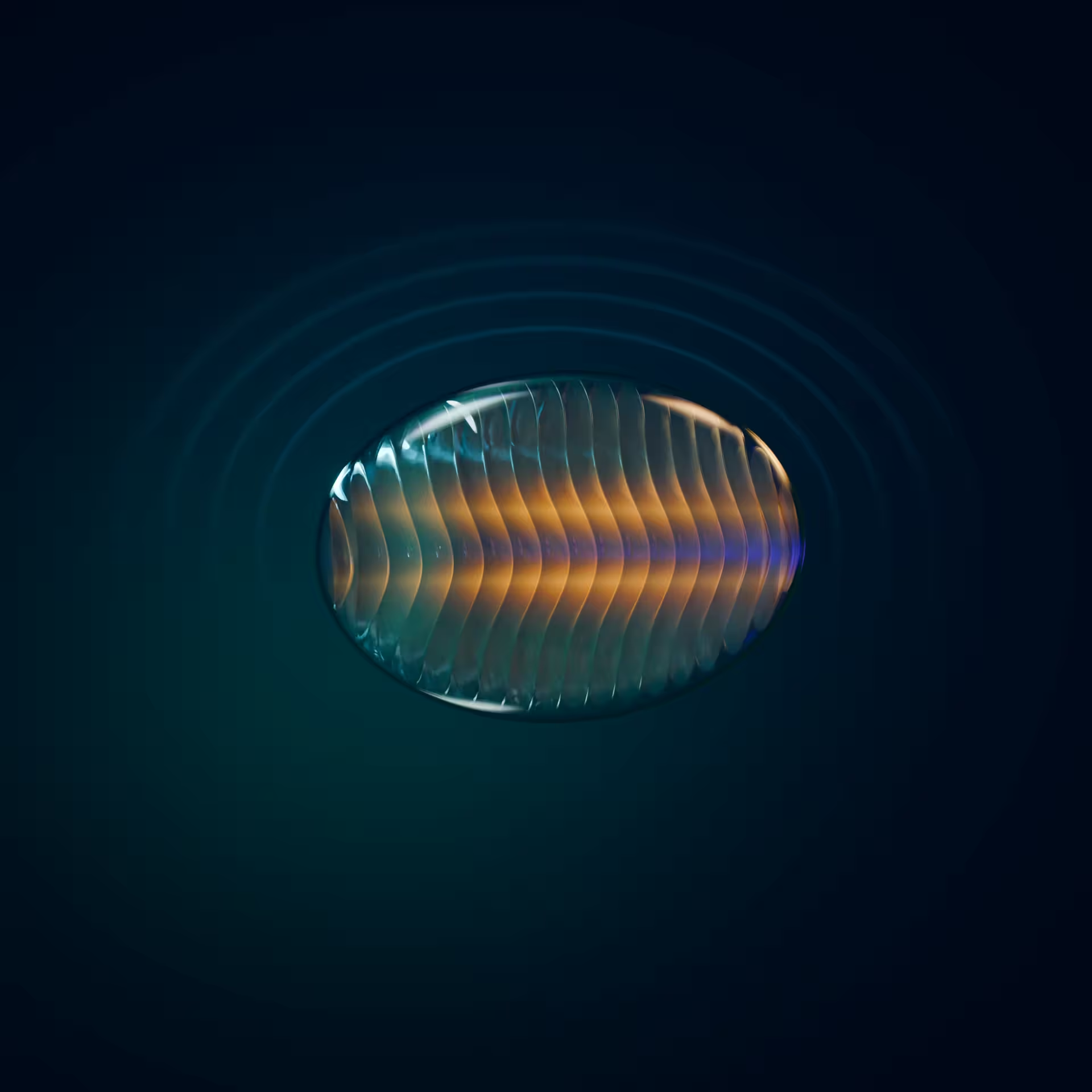
Tuning Fork of Silence is a digital sculpture about precision and attention to the barely perceptible. Inside a transparent form, the rhythm of the inner membranes changes. A small deviation begins a story about detecting a hidden difference and acting within its boundaries while preserving the whole.
CONCEPT AND STORY
The work was included in the digital exhibition “Brave New Art: Five Scientific Discoveries Through the Eyes of Contemporary Artists”. A joint project by Pravila Zhizni and the Sber Science Award, the exhibition brings together art and the research of the award’s laureates. It was curated by Kseniya Korobeynikova.
The work is dedicated to Boris Alekseev, an oncologist and surgeon whose work focuses on prostate cancer diagnosis and treatment. His developments include molecular genetic diagnostic panels that help identify aggressive forms of the disease more accurately. In 2025, Alekseev received the Sber Science Award in the Life Sciences category.
As I learned about his work, one thought stayed with me: things that look alike can be very different inside. Recognising that difference matters when choosing an approach to treatment. I wanted to translate this idea into form, light and movement, showing the very moment when something hidden becomes visible.
ARTISTIC INTENT
I chose a tuning fork as a metaphor. In the title, it suggests tuning and paying attention to a response. Within the sculpture, a few elements respond to a shared impulse differently from the rest. Their difference can only be noticed in motion.
This is an artistic interpretation of a scientific idea, not a depiction of a medical method. I wanted to explore precise detection and local action that leaves the form intact. “Silence” means stillness here: the material stays in place even when its movement subsides.
This is an artistic interpretation of a scientific idea, not a depiction of a medical method. I wanted to explore precise detection and local action that leaves the form intact. “Silence” means stillness here: the material stays in place even when its movement subsides.
MOVEMENT AND PERCEPTION
At first, 18 thin glass membranes inside the transparent oval oscillate in unison. A wave of light passes through the form, and a small group of membranes begins to lag behind. Nothing in their appearance sets these elements apart, so the viewer notices the change against a shared rhythm that has already become familiar.
Waves travel towards one another, creating a moiré pattern. Their luminous intersections converge around a small oval area, defining its boundaries. Movement within this area almost stops, while the rest of the structure continues to oscillate.
Finally, the membranes return to a shared rhythm. This return connects the end to the beginning: the viewer sees a whole object again, with nothing lost or destroyed.
VISUAL LANGUAGE
The oval form creates a sense of wholeness. Its transparency reveals both its boundary and what is happening inside. The thin membranes make a slight delay visible while preserving the sculpture’s overall silhouette.
I wanted to avoid a literal anatomical illustration or a recognisable image of disease. The difference therefore emerges through behaviour, without a contrasting patch that would immediately reveal the area. Light draws attention inward, and the fluid movement gives the viewer time to notice the change. The streamlined, futuristic form keeps the work abstract.
I wanted to avoid a literal anatomical illustration or a recognisable image of disease. The difference therefore emerges through behaviour, without a contrasting patch that would immediately reveal the area. Light draws attention inward, and the fluid movement gives the viewer time to notice the change. The streamlined, futuristic form keeps the work abstract.
PROCESS AND TECHNOLOGY
Development began with a question: how could a short visual story make a scientific principle understandable? I built a sequence of states: a shared rhythm, a barely perceptible delay, emerging boundaries, local stillness and a return to coordinated movement. This sequence became the basis for the storyboard and the animation brief.
When developing the movement, the key consideration was the relationship between a local change and the whole form. An obvious difference would reveal the story immediately; a faint one would go unnoticed. I therefore focused on the membranes’ response and the transitions between states. I wanted the meaning of the work to become clear gradually, through the movement itself.
The animation was created in Blender and rendered in Cycles. The final file was prepared at 1920 × 1920 pixels, running for approximately 22 seconds at 30 frames per second. Exports include an MP4/H.264 video and an AVIF image sequence.